


Caring for Your Drain and Drain Site
Conveniently located to serve the areas of Lake Forest, Glenview and Grayslake, IL

A surgical drain is a soft, flexible tube connected to a small plastic bulb. The bulb creates gentle suction that helps remove fluid from your surgery site and supports healing.
Before you are discharged from the hospital, you will learn how to care for the drain and drain site. Drains are usually removed between 7 and 21 days after surgery. The total fluid drained from the bulb must be less than 30 milliliters (30 cubic centimeters) in 24 hours for two consecutive days before the drain can be removed. It is important that you follow these instructions and record the amount of fluid drained from the bulb on the sheets provided. You will need to bring these recordings to your next appointment.
Contents
Anatomy / Drain Parts
- Drainage plug (use this to open and close the drainage port)
- Drainage port (empty the fluid out here)
- Measurement markers (measures fluid in cubic centimeters, or cc)
- Suction port (connects to the drain)
- Anti-reflux valve (keeps the fluid from moving back into the drain)
- Strap (for attachment to clothing)
Care of the drain and drain site
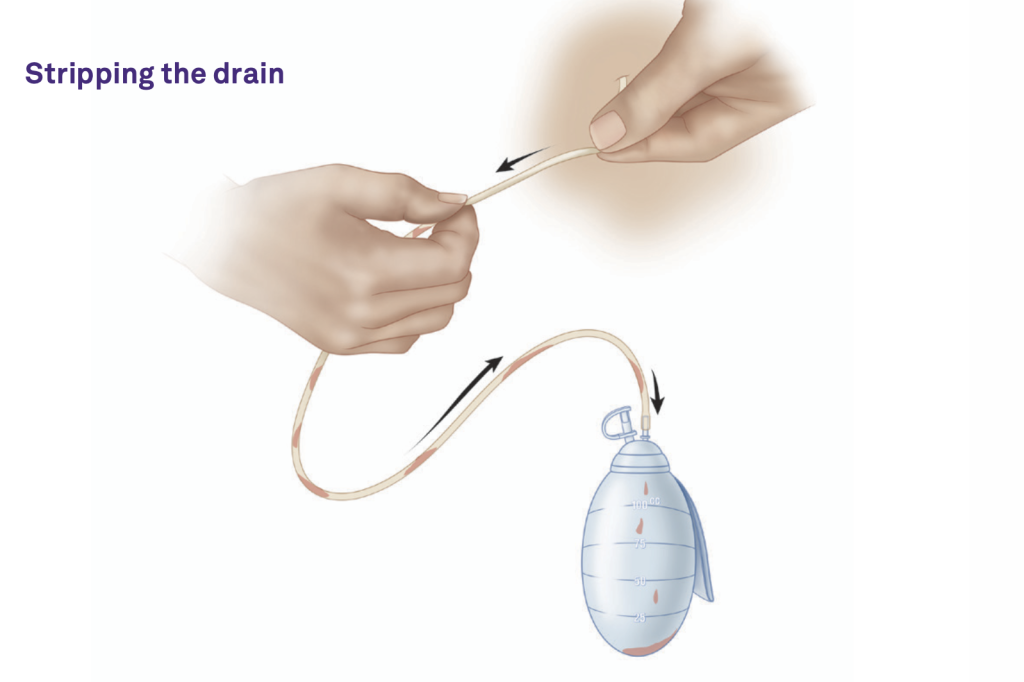
- The drain should be “stripped” 3 or 4 times a day while you are awake. To do this, hold the drain near where it comes out of your body with 1 hand. Use the other hand’s thumb and forefinger to squeeze the tube and move all the way down to the bulb. You can use 2 alcohol pads on either side of the tubing to help it glide more easily.
- Clean the area around the drain with soap and water 2 times a day.
- Apply ointment to the drain insertion site 2 times a day.
- Cover with a bandage as needed.
To empty the bulb
- Wash your hands.
- Hold the bulb upright (drainage plug on top).
- Remove the drainage plug to release pressure.
- Allow the bulb to fully expand.
- Turn the bulb upside down and gently squeeze the fluid into the medicine cup for accurate measurements.
- Place the medicine cup on the counter for level, accurate measurement.

To reactivate the suction
- Squeeze the bulb to remove the air. You can fold the drain in half to help.
- While squeezing, close the drainage plug.
- Release the bulb.
- The bulb should stay collapsed or concave.

Important to remember
- Always wash your hands before and after handling the drain.
- Be sure to empty the bulb before it fills completely or the drain will not work properly. During the 1st few days after surgery, this will usually be 2 to 3 times a day (or more, if the bulb is filling up).
- Keep accurate records of the amount of fluid emptied from the bulb. If you have more than 1 drain, empty and record each separately. Do not mix the output from the separate drains. Make sure to measure all drains at the same time of day.
- Be careful to keep the drain plug tightly in place. An airtight seal is necessary for the system to work properly.
- Pay attention to how your wound is healing.
After the drain is removed
- You may shower the same day.
- Apply ointment to the drain site for 2 days following the drain removal.
- Cover with a bandage for 2 days, or until drainage stops coming from the incision site.
Call our office if any of these occur:
- The drain falls out.
- The drain becomes clogged.
- There is redness around the site bigger than the size of a quarter (local irritation is normal and expected).
- Fluid collects around the drain site.
- The bulb does not stay flat after reactivating the suction.